


The Corporate is Headquartered In Bethlehem
페이지 정보

본문
A central oil channel in the conductor facilitates oil movement in cables up to 525 kV for when the cable gets warm however rarely used in submarine cables due to oil pollution risk with cable damage. The whole cable core is impregnated with a low-viscosity insulation fluid (mineral oil or synthetic). Certain formulations of XLPE insulation may also be used for DC. When the explanations for top voltage transmission, the choice for AC, and for capacitive currents are mixed, one can perceive why there aren't any underwater high electric energy cables longer than a thousand km (see the table in "Operational submarine energy cables" part beneath). A wire or cable has a voltage (to impartial) score and a maximum conductor floor temperature ranking. A submarine power cable is a transmission cable for carrying electric power under the surface of the water. These are called "submarine" as a result of they often carry electric energy beneath salt water (arms of the ocean, seas, straits, and so forth.) but additionally it is possible to use submarine power cables beneath recent water (giant lakes and rivers).
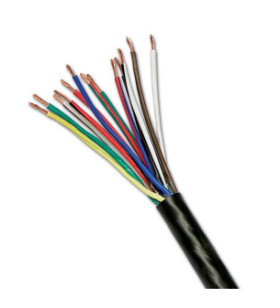 In this stage the product is called cable core. The electric core is a concentric meeting of internal conductor, electric insulation, and protecting layers (resembling the design of a coaxial cable). In single-core cables the core is surrounded by concentric armoring. Wires and cables are rated by the circuit voltage, temperature score and environmental conditions (moisture, sunlight, oil, chemicals) in which they can be used. An electric transmission system embodying a co-axial cable comprising an internal insulating sheath and a centre conductor, an auxiliary conductor helically wound over stated sheath in such a manner as to kind a balanced circuit for reducing low frequency interference, a conducting sheath oi' lead surrounding the auxiliary conductor, interior sheath and centre conductor for lowering or eliminating interference at excessive frequencies, and tape of mushy iron applied externally to the sheath of l lead for lowering interference at frequencies intermediate the said low and excessive frequencies. The invention is concerned with the transmission programs employing cables comprising a central conductor which is air-spaced from a surrounding conducting sheath for the greater a part of its length. Conductor sizes ≤ 1200 mm2 are most common, however sizes ≥ 2400 mm2 have been made often.
For voltages ≥ 12 kV the conductors are spherical in order that the insulation is uncovered to a uniform electric field gradient. Cables ≥ 52 kV are equipped with an extruded lead sheath to forestall water intrusion. It's produced by extrusion, with an insulation thickness of up to about 30 mm; 36 kV class cables have solely 5.5 - 8 mm insulation thickness. Low-stress oil-filled cables have an insulation lapped from paper strips. Electrical cables are used to attach two or more devices, enabling the switch of electrical signals or power from one machine to the other. It's discovered with a transmision system constructed in accordance with the invention, that interference might be lowered or eliminated over a frequency vary extending from very low frequencies up to some two megacycles or more. An electrical cable is an assembly of one or more wires operating aspect by side or bundled, which is used as an electrical conductor to hold electric current. Physically, an electrical cable is an assembly consisting of one or more conductors with their own insulations and optionally available screens, particular person coverings, meeting protection and protective covering. Physically, an electrical cable is an assembly consisting of one or more conductors with their own insulations and optionally available screens, individual coverings, meeting safety and protective coverings.
Such cables have a certified fireplace resistance score and are more costly than non-hearth-rated cable. The objective of this paper is to assess the feasibility of reflectometry strategies for the monitoring of insulator injury in electric cables. To keep away from estimating numerous discretized conductance values alongside an extended cable, the proposed method relies on sparse regression, which robotically focuses on localized conductance variations at unknown positions caused by accidental insulator damage. While shunt conductance is a direct health indicator of cable insulation, measuring the cable common shunt conductance will not be ample for the detection of localized insulator damage, since localized conductance variations are diluted over a protracted cable length in such measurements. Numerical simulations show the potential of this method for quick estimation of localized shunt conductance variations. One methodology of decreasing interference in cables of the kind to which the present invention relates, requires an auxiliary conductor associated with the central conductor to constitute a balanced circuit. The earliest standardized technique of wiring in buildings, in widespread use in North America from about 1880 to the thirties, was knob and tube (K&T) wiring: single conductors had been run via cavities between the structural members in walls and ceilings, with ceramic tubes forming protecting channels by joists and ceramic knobs attached to the structural members to offer air between the wire and the lumber and to support the wires.
Should you adored this short article and also you would like to get more information about electric cable generously stop by our own web site.
- 이전글비아그라 구매 전 꼭 알아야 할 정보 정리 26.04.03
- 다음글Smart Numbers for Quick Verification 26.04.03
댓글목록
등록된 댓글이 없습니다.